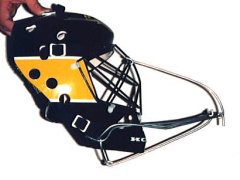
(Click on the images for a more detailed explanation.)
The method of head construction that I use begins with a street hockey helmet (or any other suitable helmet or hardhat). A frame of tension wire (used in the construction industry) gives the head a rigid shape. A layer of nylon mesh (needlepoint fabric) fastened to the frame with electrical tie-wraps gives it a smoothly curved surface.
The beak is a thin layer of Magic-Sculp epoxy resin molded onto the nylon mesh, then sanded, painted and varnished.
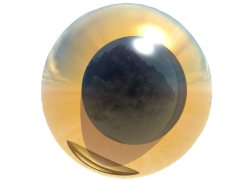
For the griffin's eagle eyes, I used half of a hollow plastic ball (from a toy store or plastic supplier). A disc of needlepoint fabric (used to make coasters) is the "white" of the eye. A carefully cut ring of amber mylar, detailed with fine tip red and black markers, is the iris. And a piece of expanded metal mesh from a frying pan spatter screen, darkened in the center with a black marker pen, is the pupil.
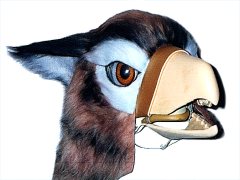
The lower part of the beak is movable. Small springs hold it closed (but delicately balanced), and a small pressure pad couples its movement to my own jaw. The hinge point is just an inch or two behind my chin, so the motion is exaggerated proportionally.