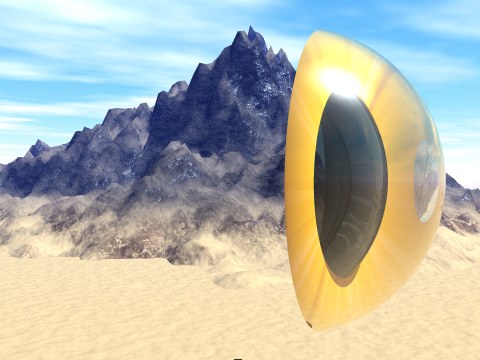
| The complex look
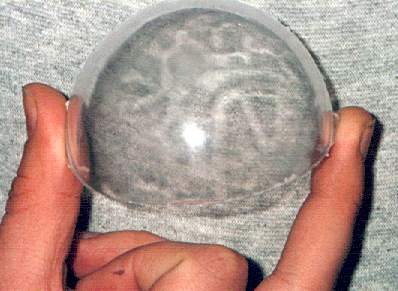
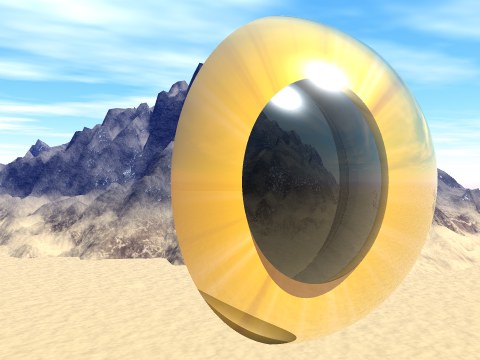
of the eye is achieved with three layers of material inside the hemisphere,
positioned at the back (the flat side). The iris is a simple
ring of yellow mylar. I drew thin red radial lines near the
outside edge, and a harder brown line at the edge itself with colored
paint markers. This gives the illusion of the yellow fading
into orange, then deep brown -- the colors of an eagle's eye.
The shiny mylar also reflects room highlights, adding to the effect.
If you look
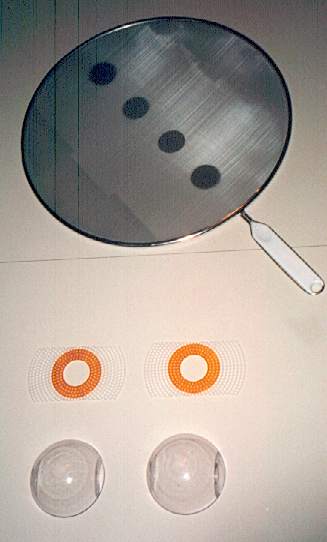
closely, you'll see that the mylar rings are stuck to pieces of
white plastic mesh (the same material used elsewhere in the head).
These discs were evidently designed for needlepoint coasters, and
are 10 for a dollar. The mylar was stuck to the mesh with
a very light coat of Scotch 77 spray adhesive.
Finally, the
plastic mesh is backed up with a piece of metal mesh cut from a
frying pan spatter screen (a few dollars at a kitchenware store
in the mall). This mesh is not screen, but rather a solid
metal sheet with very fine holes in it. It's perfect for
the inner part of the eye -- it's strong, and it doesn't unravel
when you cut it. I colored the pupil area black with a paint
marker.
|